campbell book: evolution
Showing posts with label evolution. Show all posts

Friday, September 7, 2012

Charles Darwin and the Theory of Natural Selection

12:32 AM 0
Charles Darwin and the Theory of Natural Selection

The history of life, as documented by fossils and other evidence, is a saga of a changing Earth billions of years old, inhabited by an evolving cast of living forms (Figure 1.17). This evolutionary view of life came into sharp focus in November 1859, when Charles Robert Darwin published one of the most
important and influential books ever written. Entitled On the Origin of Species by Means of Natural Selection, Darwin's book was an immediate bestseller and soon made "Darwinism" almost synonymous with the concept of evolution (Figure 1.18)

Figure 1.17 Digging into the past. Paleontologist Paul Sereno, of the University of Chicago. gingerly excavates the leg bones of a dinosaur fossil in Niger.

The Origin of Species articulated two main points. First, Darwin presented evidence to support his view that contemporary species arose from a succession ofancestors. (We will discuss the evidence for evolution in detail in next Chapter.)
Darwin called this evolutionary history of species "descent with modification" It was an insightful phrase, as it captured the duality of life's unity and diversity-unity in the kinship among species that descended from common ancestors; diversity in the modifications that evolved as species branched from their common ancestors (Figure 1.19).
Darwin's second main point was to proposea mechanism for descent with modification. He called this evolutionary mechanism natural selection.
Darwin synthesized his theory of natural selection from observations that by themselves were neither new nor profound. Others had the pieces of the puzzle, but Darwin saw how they fit together. He started with the following observations from nature: Individuals in a population vary in their traits, many of which seem to be heritable (passed on from parents to offspring), Also, a population can produce far more off spring than can survive to produce offspring of their own. With more individuals than the environment can support, competition is inevitable. Lastly, species generally suit their environments.

Figure 1.19 Unity and diversity in the orchid family.
These three rain forest orchids are variations on a common floral theme. For example, each of these flowers has a liplike petal that helps attrad pollinating insedS and provides a landing platform for the pollinators.

Figure 1.20 Natural selection. This imaginary beetle population has colonized alocale where the soil has been blackened by a recent brush fire. Initially, the population varies extensively in the inherited coloration of the individuals, from very light gray to charcoal. For hungry birds that prey on the beetles, it is easiest to spot the beetles that are lightest in color

For instance, birds living where tough seeds are a good food source may have especially strong beaks. Darwin made inferences from these observations to arrive at his theory of evolution. He reasoned that individuals with inherited traits that are best suited to the local environment are more likely to survive and reproduce than less fit individuals. Over many generations, a higher and higher proportion of individuals in a population will have the advantageous traits. Evolution occurs as the unequal reproductive success of individuals adapts the population to its environment.
Darwin called this mechanism of evolutionary adaptation "natural selection" because the natural environment "selects" for the propagation of certain traits. The example in Figure 1.20 illustrates the ability of natural selection to "edit" a population's heritable variations in color. We see the products of natural selection in the exquisite adaptations of various organisms to the special circumstances of their way of Hfe and their environment

Wednesday, July 18, 2012

Evolution Accounts for the Unity and Diversity of Life

1:38 AM 0
Evolution Accounts for the Unity and Diversity of Life
The list of biological themes discussed under Concept 1.1 is not absolute; some people might find a shorter or longer list more useful. There is consensus among biologists, however, as to the core theme of biology: It is evolution. To quote one of the founders of modern evolutionary theory, Theodosius Dobzhansky, "Nothing in biology makes sense except in the light of evolution."
In addition to encompassing a hierarchy of size scales from molecules to the biosphere, biology extends across the great diversity of species that have ever lived on Earth. To understand Dobzhansky's statement, we need to discuss how biologists think about this vast diversity.

Organizing the Diversity of Life.
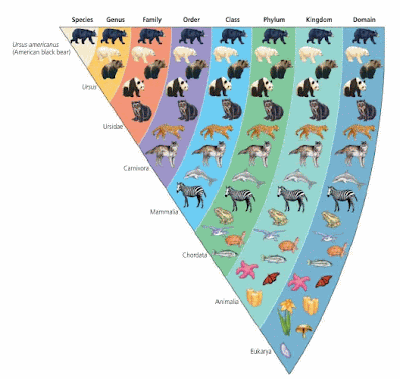
Diversity is a hallmark of life. Biologists have so far identified and named about 1.8 million species. To date, this diversity of life is known to include at least 6,300 species of prokaryotes (organisms with prokaryotic cells), 100,000 fungi, 290,000 plants, 52,000 vertebrates (animals with backbones), and 1 million insects (more than half of all known forms of life). Researchers identify thousands of additional species each year. Estimates of the total number of species range from about 10 million to over 100 million. Whatever the actual number, the enormous variety of life gives biology a very broad scope. Biologists face a major challenge in attempting to make sense of this variety (Picture 1).

Grouping Species: The Basic Idea
There is a human tendency to group diverse items according to similarities. For instance, perhaps you organize your music collection by artist. And then maybe you group the various artists into broader categories, such as rock, jazz, and classical.
In the same way, grouping species that are similar is natural for us. We may speak of squirrels and butterflies, though we recognize that many different species belong to each group. We may even sort groups into broader categories, such as rodents (which include squirrels) and insects (which include butterflies). Taxonomy, the branch of biology that names and classifies species, formalizes this ordering of species into groups of increasing breadth (see Picture 1).
You will learn more about this taxonomic scheme in Chapter 26. For now, we wm focus on kingdoms and domains, the broadest units of classification.

The Three Domains of Life
Until a few decades ago, most biologists adopted a taxonomic scheme that divided the diversity of life into five kingdoms: plants, animals, fungi, single-celled eukaryotic organisms, and prokaryotes. Since then, new methods, such as comparisons of DNA sequences from different species, have led to an ongoing reevaluation of the number and boundaries of kingdoms.
Researchers have proposed anywhere from six kingdoms to dozens of kingdoms. But as debate continues at the kingdom level, there is a consensus that the kingdoms of life can now be grouped into three even higher levels of classification called domains. The three domains are named Bacteria,
Archaea, and Eukarya (Picture 2, 3, and 4).

The organisms making up domain Bacteria and domain Archaea are all prokaryotic. Most prokaryotes are singlecelled and microscopic. In the five-kingdom system, bacteria and archaea were combined in a single kingdom because they shared the prokaryotic form of cell structure. But much evidence now supports the view that bacteria and archaea represent two very distinct branches of prokaryotic life, different in key ways that you'll learn about in Chapter 27. There is also evidence that archaea are at least as closely related to eukaryotic organisms as they are to bacteria.
All the eukaryotes (organisms with eukaryotic cells) are now grouped in domain Eukarya. In the era of the five-kingdom scheme, most single-celled eukaryotes, such as the microorganisms known as protozoans, were placed in a single kingdom, "Protista." Many biologists extended the boundaries of kingdom Protista to include some multicellular forms, such as seaweeds, that are closely related to certain unicellular protists. The recent  taxonomic trend has been to split the protists into several groups at the kingdom level. In addition to these protistan groups, domain Eukarya includes three kingdoms of multicellular eukaryotes: kingdoms Plantae, Fungi, and Animalia. These three kingdoms are distinguished partly by their modes of nutrition.
Plants produce theirown sugars and other foods byphotosynthesis. Fungi absorb dissolved nutrients from their surroundings; many decompose dead organisms and organic wastes (such as leaflitter and animal feces) and absorb nutrients from these sources. Animals obtain food by ingestion, which is the eating and digesting of other organisms. Animalia is, of course, the kingdom to which we belong.

Unity in the Diversity of Life
As diverse as life is, it also displays remarkable unity. Earlier we mentioned the similar skeletons of different vertebrate animals, but similarities are even more striking at the molecular and cellular levels. For example, the universal genetic language of DNA is common to organisms as different as bacteria and animals. Unity is also evident in many features of cell structure.
How can we account for life's dual nature of unity and diversity?
The process of evolution, explained next, illuminates both the similarities and differences in the world ofHfe and introduces another dimension of biology: historical time.


Picture 1: Classifying life . To help organize the diversity of life. biologists classify species into groups that are then combined into even broader groups, In the traditional "linnaean" system. species that are very closely related, such as polar bears and brown bears, are placed in the same genus; genera (plural) are grouped Into families; and so on. This example classifies the species Ursus americanus, the American black bear, (Alternative classification schemes will be discussed in detail in Chapter 26.)


Picture 2: DOMAIN BACTERIA. Bacteria are the most diverse and widespread prokaryotes and are now divided among multiple kingdoms, Each of the rod-shaped structures in this photo is a bacterial cell.


Picture 3: DOMAIN ARCHAEA. Many of the prokaryotes known as archaea live in Earth's extreme environments. such as salty lakes and boiling hot springs. Domain Archaea includes multiple kingdoms, The photo shows a colony composed of many cells.


source : campbell and reece book